My mother and I enjoyed a talk and tour round Park Farm in Great Holland with Mr Elsworth, who owns and runs it as a thriving enterprise, a few weekends ago. Having recently planted three fruit trees in our back garden I was interested to learn what I could about looking after them - and encouraging fruitfulness of course.
Along the way he also shed light on changes for small to medium sized fruit producers since he took over the farm from his father, who first established it in 1935. There's no doubt the environment has become very tough for them.
For a start, only about 1/6th of the farm's original 60 hectares of orchards, is now devoted to fruit. Most of what they grow is sold locally, mainly through their own shop - and none through supermarkets or wholesalers, the latter were an important route to market in his father's time. Mr Elsworth related his last experience of delivering Discovery apples, usually the first early variety of the English apple season, up to the London markets one year, when most other UK growers' crops had failed. A peculiarity of the local coastal climate had saved his crop and he sent them up by train, expecting a good price in conditions of scarcity. They didn't sell, and he hadn't sent any away since.
The farm is not organic and I was mildly amused by his brief summary of why not. Apparently people who support organics think you don't use chemicals to sort out pests and yet organic farmers do need to use them. He said the knack to producing good quality fruit was to grow healthy trees, then disease wouldn't take hold. To me that is exactly what organic growing is all about! Using as little chemicals as possible, and those from an approved list of poisons derived from natural substances. Ah well, no one is perfect.
Most of the work of the farm is done by human beings and it's no picnic running a farm of this size, much of the outdoor work with casual labour. Young people don't stay on in permanent employment - he's just got them trained and they move on to something else. He commented wryly that if he needs 16 people to prune or pick apples he has to ask 20 to come in as he knows about a fifth won't turn up. In his experience, migrant labourers are more reliable - partly because they live onsite during the season so he knows where to find them when needed!
Beyond the problems of farming, he also shared some useful information for we gardeners! He showed us the Writtle College method of picking apples - cupping the fruit in your hand and rolling, rather than tugging it off the branch so the stalk stays on and keeps the fruit sealed and whole for storage (if the apples don't roll off easily they aren't ready). And he shared a technique to use alongside pruning for perfectly formed fruit trees - small concrete weights made in egg cartons and hung on individual branches to encourage them to grow outwards rather than up, for better productivity. He also uses calcium foliar feeds as needed, as this nutrient is difficult to administer in any other form.
We were surprised to hear that honey bees are not as useful as they're cracked up to be for pollination of fruit trees! Apparently the lazy things don't come out unless the weather is warm
(not always the case in our British spring). Other insects ( including other types of bee) are hardier, out earlier, and seem to do the job as well. Plus, the more flowers are pollinated, the more tiny fruits have to be removed from the trees in early summer (thus incurring additional labour costs) in order to produce a good crop of evenly spaced healthy apples! Over the last couple of years, the local beekeeper has taken his hives elsewhere and the crop has been more than adequately pollinated in their absence.
Park Farm produces 40 varieties of apple and it's a real treat to visit the farm's shop and choose. This time we brought home George Cave, Blenheim Orange, Egremont Russet and Ashmead's Kernel, all of excellent quality. We also had three litres of their fresh unpasteurised apple juice, which is usually available in at least three different varieties and vastly superior to (even the good) stuff from supermarket chiller cabinets. They supply boxes of fruit - follow the link above for further information. And if you should be somewhere near Clacton, do drop in for local vegetables and other fresh foods - and try their recently opened coffee shop, which does very reasonable lunches and delicious home baked cakes and desserts.
Showing posts with label fruit growing. Show all posts
Showing posts with label fruit growing. Show all posts
Sunday, 8 November 2009

Thursday, 15 October 2009
Garden Bloggers Bloom Day October 2009

Welcome to the highlights of my garden on this sunny autumn day...thanks as always to MayDreams Gardens for hosting this monthly beautiful event, an opportunity to share and enjoy so many gardens around the world.
The front border is flourishing with aster and dark leaved Eupatorium especially joyful this month - the aster a little past their best, some have gone to seed but their cheerful little faces enjoying the sun
 and continuing to feed local bees and other beneficial insects.
  Eupatorium has had a tough autumn, it has been very hot and dry, at one point in September I realised it was drooping and slung a can of water over it. It was moved from another part of this bed last spring, I'm hopeful its many flowers are a sign of health not desperation!
Sedum, cyclamen, Euonymus and Euphorbia have all settled in well to their pot at the front door. They were planted out just a couple of weeks ago having hung around since late August - so that's a relief.
In the back garden, spectacular autumn colour f
 rom Hamamelis Vesna; the leaves turn rich brown, then take on a deep orange hues, some with red and yellow edges. Well worth the space it occupies at this time of year, it is said to grow up to 8 foot and I'm looking forward to it. (In the left corner, a glimpse of acid yellow Potentilla, still flowering. I mentioned its long season back in July).
Next, a new addition to the sunny border, Malus Gorgeous was completely irresistible with its sunset
 coloured crab apples, turning to red, from RHS Wisley a couple of weeks ago. We've also put in quince Meech's Prolific and an apple, Adam's Pearmain this week. It has
  taken eight years to decide which fruit trees to plant (I know, we could have had some decent crops by now!) but we finally agreed on our selection, and looking forward to the spring blossom lighting up the garden. All will need expert pruning in our modest garden in order to produce well and thrive without taking over!
A couple of fresh white cyclamen have lit up this terracotta pot,with its variegated holly and thyme, which thrived in a lightly shaded spot over summer.
Lastly, yellow flowers like this pretty specimen are borne above the Jerusalem artichoke, which was covered with them when we visited the allotment last week to plant out garlic and onions. A welcome veg bloom for October!
Sunday, 27 September 2009
Croquet at Polesden Lacey...
We've spent most of the weekend outdoors enjoying the warm bright autumn weather. No, not in the garden, but in the Surrey Hills of South East England, where we wandered through lovely woodland, catching a glimpse of a small wild deer on our way, to spend Saturday night at Tanners Hatch youth hostel with friends from Making Colliers Wood Happy.
Along the lane from the railway station, hedgerows were full of fruit; blackberries, rosehips, red honeysuckle berries and elderberries (even though many, it seemed, had been recently pruned). As we walked through the fields, we spotted a buzzard lazily circling, a pair of herons flew past, and a small flock of goldfinches.
The hostel is just across the valley from Polesden Lacey, a large 18th century house owned by the National Trust, so in under half an hour we were able to walk up this morning and enjoy a lazy lunchtime picnic on the sunny lawns. They have a new farm shop, so we made our own picnic with fresh bread and deli treats, as the restaurant wa s very busy with the usual Sunday lunchtime trade, and none of us wanted to be indoors queueing.
The house is set into the hillside, surrounded by landscaped terraced lawns, a walled garden, some less formal meadows, and overlooking a peaceful view of the wooded countryside. there are two croquet pitches laid out on one of the lawns. A game was irresistible; we all enjoyed a couple of rounds in the gorgeous sunshine, although none had a firm grasp of the rules.
As the third round began, I took the opportunity to explore the walled garden. A lovely mixed border along the outside, but what lay within?
I found series of separate small gardens devoted to different plants and layouts, with tall yew hedges dividing them. M y first discovery was an historic collection of bearded irises, not that any were in flower, but naturally the beds were neatly laid out and I imagine it will look wonderful from spring next year.
The rose garden was also very striking; the scent was delicious - alm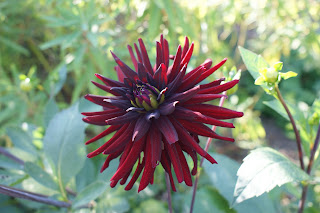 ost overwhelming - and the beds are planted up with single varieties, great blocks of colour which look absolutely wonderful.
I suppose no autumn posting would be complete without at least one chrysanthemum; in the corner of the rose garden there was a whole bed of them, acid yellows, bright scarlets, oranges and apricots and some dark pinks scattered among them. But they looked garish, rather than colourful, in my picture; so here's a single quite delicious bloom from a quieter bed!
As we started home along the Yew Walk (also a lawn) which constitutes the lowest boundary of Polesden Lacey's gardens, we noticed holly trees heavily laden with fruit, by tradition a sign of a hard winter coming. But there will be plenty here for the birds to eat, with the yew trees also thickly covered in small soft red jewels.
It's still possible to make a donation to WaterAid in support of Sing for Water 2009. And you can now see our performance on Youtube, where there are two ten minute videos of the 650 strong choir which came together from across the UK to the Scoop in London for this special event.

Along the lane from the railway station, hedgerows were full of fruit; blackberries, rosehips, red honeysuckle berries and elderberries (even though many, it seemed, had been recently pruned). As we walked through the fields, we spotted a buzzard lazily circling, a pair of herons flew past, and a small flock of goldfinches.
The hostel is just across the valley from Polesden Lacey, a large 18th century house owned by the National Trust, so in under half an hour we were able to walk up this morning and enjoy a lazy lunchtime picnic on the sunny lawns. They have a new farm shop, so we made our own picnic with fresh bread and deli treats, as the restaurant wa
 s very busy with the usual Sunday lunchtime trade, and none of us wanted to be indoors queueing.
The house is set into the hillside, surrounded by landscaped terraced lawns, a walled garden, some less formal meadows, and overlooking a peaceful view of the wooded countryside. there are two croquet pitches laid out on one of the lawns. A game was irresistible; we all enjoyed a couple of rounds in the gorgeous sunshine, although none had a firm grasp of the rules.
As the third round began, I took the opportunity to explore the walled garden. A lovely mixed border along the outside, but what lay within?
I found series of separate small gardens devoted to different plants and layouts, with tall yew hedges dividing them. M
 y first discovery was an historic collection of bearded irises, not that any were in flower, but naturally the beds were neatly laid out and I imagine it will look wonderful from spring next year.
The rose garden was also very striking; the scent was delicious - alm
 ost overwhelming - and the beds are planted up with single varieties, great blocks of colour which look absolutely wonderful.
I suppose no autumn posting would be complete without at least one chrysanthemum; in the corner of the rose garden there was a whole bed of them, acid yellows, bright scarlets, oranges and apricots and some dark pinks scattered among them. But they looked garish, rather than colourful, in my picture; so here's a single quite delicious bloom from a quieter bed!
As we started home along the Yew Walk (also a lawn) which constitutes the lowest boundary of Polesden Lacey's gardens, we noticed holly trees heavily laden with fruit, by tradition a sign of a hard winter coming. But there will be plenty here for the birds to eat, with the yew trees also thickly covered in small soft red jewels.
It's still possible to make a donation to WaterAid in support of Sing for Water 2009. And you can now see our performance on Youtube, where there are two ten minute videos of the 650 strong choir which came together from across the UK to the Scoop in London for this special event.
Tuesday, 8 September 2009
Any ideas for green figs?
 Even here in the blessed South East of England, you only get one picking of figs - and that's in a good year.
We picked our first crop of three purple ripe fruits last month from a Brown Turkey fig tree planted some five years ago. They were delicious.
But this week I twisted off 10 small green figs which have no chance of maturing, in the hope that some tiny buds will form, overwinter and ripen next summer.
Really I should have done this earlier in the season, and pruned, but fingers crossed we will have an Indian summer, the buds will form, and we will have a few figs to enjoy again next year.
Whether you've needed to water your garden this week or not, please support WaterAid this week and help them provide clean water supplies and sanitation for poor communities in Africa.
Subscribe to:
Posts (Atom)
