Glorious sunny Sunday afternoon in the back garden. You know how as the season starts, it's hard to decide what to do first? I wandered round for almost an hour looking at the mess and wondering where to start, despite P having given the lawn its first cut of 2011 earlier in the day.
Oak leaves strewn all over the place ( including covering the surface of the pond - is it too late to clear it?).
Witch hazel, so overwhelmed by last summer's honeysuckle growth - and then the winter's - that we could barely see it flowering back in January and February, and the branches now completely invisible, as was the flower bed beneath.
Paving at the bottom of the garden full of junk - plastic pots all over the place, open bags of compost, more oak leaves. Piano finally falling apart - I suppose it's had at least four years out here, doesn't owe us anything.
Weeds covering the shady side flower bed, with barely a sign of bulbs coming through, although the comfrey was coming into flower and buddleia and black elder already starting into leaf. And what's that horrible smell, is it the drains, the pond or the compost bin?
Alas dear readers it was the compost bin, my first experience of what can happen to worms in a plastic bin when you have a two nights of hard frost followed by a couple of very warm afternoons. I draw a discreet veil over the details, hose followed by hot water and bleach is all I will say. Not the best start to my gardening year.
After that, though, all was pleasure and industry - well I don't have to describe pottering and pruning to you. Out with the secateurs and string to tie up climbing roses and prune back honeysuckle; finding the sunny side full of columbine to look forward to later in the spring; weeding the shady side and spotting the grape hyacinths and allium just poking through; sorting out the pots so the daffodils and hyacinths look their best; deciding the pond can wait for another day; and finally the delight of a late afternoon bonfire and enjoying a beer while the sun went down.
And then coming indoors to find a vase full of pale yellow daffodils from the front garden.
I'm really looking forward to the growing season ahead, and I hope your Sunday afternoon was as full of pleasures and plants as mine.
Sunday, 20 March 2011

Wednesday, 2 February 2011
Oranges and lemons
Something of a CitrusFest at home today. It's marmalade season, so I started preparing Seville oranges this morning. Splitting each fruit in half, squeezing the juice and reserving all the pips - many more than your usual oranges, and a great source of pectin, which makes the marmalade set - then paring the peel (taking care to slice close to the skin, as too much of the white pith would make the final product bitter). One and a half kilos of oranges later, (some prepared by beloved, who finished the job while I had some soup for lunch) I squeezed a couple of lemons, bagged up the pips and orange flesh, added two and a half litres of water and set the whole lot to stew gently for a couple of hours until the peel was tender and the kitchen full of wintry scented orangeness.
I had a load of lemons in the fridge too, so while I was waiting, thought I would have my first crack at lemon curd. This is a delicious preserve, and very simple to make - don't know why I haven't done it before. For three jars of curd I needed four lemons, four ounces (100g) of butter, four free range eggs and a pound (450g) of sugar.
Squeeze the lemons, grate the peel, put together with the other ingredients in a large heatproof bowl over barely bubbling saucepan of hot water and stir occasionally for about an hour. when it thickens (like a delicious lemony custard), strain and pot up in sterilised jars, then eat - with toast, in muffins and tarts, or however you like it - within about a month. It will keep in a cool cupboard but needs to be refrigerated once opened.
Once the curd was done, I got back to the marmalade, which by now had reduced by about a quarter. I added 2 kg of preserving sugar, stirred, tasted, then added about 1 and a half more, brought it to the boil and kept it going, stirring occasionally with a wooden spoon for about 40 minutes until it looked a couple of shades darker and was just about setting on spoon. I find with jam, I can use the saucer technique, where you test a teaspoon of the mix on a cold saucer and if it wrinkles when you push it with your finger it's reached setting point. Marmalade may have overcooked if I get it to that stage, so it's worth stopping sooner and having a lighter set so it doesn't go bitter and burnt tasting. Looks prettier in the jar too!
Finished abour 5 pm and felt I'd almost done a full day's work! Though this time of the year it's great to stand over a hot stove and stir up something delicious on my day off. P took over in the kitchen to make a sausage supper and then we headed out to the Jolly Coopers on Epsom Common, for live music (including our son's band) at their monthly jam night. How appropriate!
I had a load of lemons in the fridge too, so while I was waiting, thought I would have my first crack at lemon curd. This is a delicious preserve, and very simple to make - don't know why I haven't done it before. For three jars of curd I needed four lemons, four ounces (100g) of butter, four free range eggs and a pound (450g) of sugar.
Squeeze the lemons, grate the peel, put together with the other ingredients in a large heatproof bowl over barely bubbling saucepan of hot water and stir occasionally for about an hour. when it thickens (like a delicious lemony custard), strain and pot up in sterilised jars, then eat - with toast, in muffins and tarts, or however you like it - within about a month. It will keep in a cool cupboard but needs to be refrigerated once opened.
Once the curd was done, I got back to the marmalade, which by now had reduced by about a quarter. I added 2 kg of preserving sugar, stirred, tasted, then added about 1 and a half more, brought it to the boil and kept it going, stirring occasionally with a wooden spoon for about 40 minutes until it looked a couple of shades darker and was just about setting on spoon. I find with jam, I can use the saucer technique, where you test a teaspoon of the mix on a cold saucer and if it wrinkles when you push it with your finger it's reached setting point. Marmalade may have overcooked if I get it to that stage, so it's worth stopping sooner and having a lighter set so it doesn't go bitter and burnt tasting. Looks prettier in the jar too!
Finished abour 5 pm and felt I'd almost done a full day's work! Though this time of the year it's great to stand over a hot stove and stir up something delicious on my day off. P took over in the kitchen to make a sausage supper and then we headed out to the Jolly Coopers on Epsom Common, for live music (including our son's band) at their monthly jam night. How appropriate!
Saturday, 18 December 2010
Weird experience of the week...
Looking over snowy gardens from my bedroom window this morning, I saw a dolphin sail past on the roof of a car below. Looked again and realised it was a Christmas tree!
Go on, have a look next time someone drives past with a tree tied to their roof. Surely not a unique Christmas experience?
Go on, have a look next time someone drives past with a tree tied to their roof. Surely not a unique Christmas experience?
Wednesday, 1 December 2010
December


London has snow again, the dry white powder that whips in from the north east with a chill and bitter wind. Our gardens and suburban streets are transformed, trees and plants dressed with iced blossom, roofs reflecting brilliance back to grey and overcast skies. Trudging back from the park, while we carefully negotiate the crunchy treacherous paths, the children newly released from school laugh, slide and catch an icy breath of air. Little ones play Santa in their bright toboggans, their parents reindeer pulling them home for hot drinks and cosy nights in.
Sunday, 10 October 2010
Sweetcorn fungus?

P picked runner beans and sweetcorn on Monday - the beans looked promising but as they'd been on the vine so long, were very stringy, so we'll eat the rest in soups and stews without the sweet pods.

Now here's a puzzle for you - what on earth happened to this sweetcorn cob? I've looked for similar pics of sweetcorn diseases but not been able to find any free information on a quick trawl of websites. The growths appear to be full of soil or compost, it doesn't smell, it just looks gross close up. I couldn't see any bugs in it either, so assume it must be a fungus. Any ideas anyone?
Doorstep gravel garden
Unless you're excited by shrubs, cyclamen or early Christmas shopping, UK garden centres can be less than inspiring at this time of year. So it was great to visit RHS Wisley the other week and find some small but delightful plants to create a small gravel garden for our front doorstep.
I may have missed a trick by not including a small mirror as a "pond " next to the iris... but perhaps it would have looked too much like something off Blue Peter!
Isn't the yellow rose lovely? It's been flowering vigorously on our west facing patio since late August, when my mother brought it home for us.
From centre back clockwise, we found: Helleborus x Sternii; Iris Setosa; Cyclamen Coum; Oxalis Lobata; and Gentiana (which looks a


little like rosemary in this picture). Alas, I've lost the label for the last pf these plants, so not sure what variety; since planting up, it has developed the deepest blue flowers, quite heavenly in contrast to the golden oxalis.
There should be something of interest in the pot in every season as it matures, though it is quite hard to judge at this stage... I'm hoping that there will be at least three plants either in leaf or flower at any one time.
Isn't the yellow rose lovely? It's been flowering vigorously on our west facing patio since late August, when my mother brought it home for us.
Wednesday, 8 September 2010
Garden Party to Make a Difference: review
Up to the beating heart of royal London today, for a rare opportunity to visit the historic gardens at Clarence House, Lancaster House and Marlborough House, and experience the "Garden Party to Make a Difference", a unique festival devoted to ways of living more sustainably, as part of the Start campaign fronted by the Prince of Wales.
P & I had fun - we spent the morning helping with Garden Organic's contribution to the show, then were free to tour the whole site. We were giving away rocket and chard plants to people who made the One Pot Pledge, thus supporting GO's campaign to encourage more of us to start growing our own food.
GO have a very good deal on offer at the show - if you become a member (minimum £28 or £2.50 per month by direct debit) you get to choose three free packets of Duchy Original Seeds and take home a £5 Thompson and Morgan voucher - plus £5 off Heritage Seed Library membership, which entitles you to seeds of old or rare varieties to grow on your plot, save the next generation, and share with others.
As gardeners, our favourite exhibit was the Future City Garden, in a series of raised beds along the wall of Clarence House, which gave us some great ideas for recycling and saving space while growing veg. For instance, there was an attractive display of lettuces, flourishing in large yoghurt pots, set into an old door which could be leaned against a wall, shed or fence. We also liked the giant tepee-style tripods set in large buckets, supporting a good crop of golden yellow and red tomatoes. We could imagine being able to cover them with plastic sheeting early in the season to protect from rain and the dreaded blight and encourage sooner cropping.
The show has an eclectic mix of exhibitors, including independent (plant) nurseries and food and drink producers. Some of these were lined up opposite the Asda marquee, with slogans on the side about buying local that seemed somewhat... insensitive? untrue? Perhaps I've missed something about Asda's buying policies.
In any case, M&S appeared to have won the supermarkets' visual PR battle at the event. Everyone - even me - was carrying one of their striking "Twiggy" organic cotton bags. Now I know they are following Plan A (because there is no plan B in relation to climate change) but it is hard to find any organic food in their Colliers Wood or Sutton branches.
We were surprised to see how busy the Red Cross stand was - loads of people, mainly women, taking part in sewing. Brought back memories of knitting squares for charity blankets when I was young, so I'm afraid I rushed past that one. (Maybe that's why I haven't joined the great contemporary craft revival which seems so popular and much blogged about by others).
It was a shame that although we could have purchased a well known (bog standard, national brand, bottled) lager to drink for £3.50 from the onsite caterers, the independent Hogs Back Brewery was only allowed to give away small samples of their delicious real ale.
There were also entertainments (comedy and music) and talks on offer, and we especially liked the Commonwealth exhibit, a beautiful tie-dyed canopy with musical and visual presentations from around the world of people working together for a sustainable future. This was the only focus for the importance of community that we noticed at the festival; I would have liked also to see something about how communities, such as the Transition Towns movement, come together in this country, to support one another living greener lives. Doing things individually can feel demoralising sometimes.
My other disappointment, in an overall stimulating, imaginative and enjoyable event, was the lack of anything about complementary healthcare. Perhaps this was due to the closure earlier this year of the Prince's Foundation for Integrated Health? Given the growing problems of capitalism and of Western conventional medicine (eg antibiotic resistance and iatrogenic disease) - we all need to be looking after ourselves and each other with the support of traditional human knowledge, skills and methods such as herbal medicine and homeopathy, osteopathy and massage. I hope this important element of living sustainably can be included in any future event. It has always been an enjoyable part of our local Environmental Fair, organised annually by EcoLocal in Carshalton Park.
P & I had fun - we spent the morning helping with Garden Organic's contribution to the show, then were free to tour the whole site. We were giving away rocket and chard plants to people who made the One Pot Pledge, thus supporting GO's campaign to encourage more of us to start growing our own food.
GO have a very good deal on offer at the show - if you become a member (minimum £28 or £2.50 per month by direct debit) you get to choose three free packets of Duchy Original Seeds and take home a £5 Thompson and Morgan voucher - plus £5 off Heritage Seed Library membership, which entitles you to seeds of old or rare varieties to grow on your plot, save the next generation, and share with others.
As gardeners, our favourite exhibit was the Future City Garden, in a series of raised beds along the wall of Clarence House, which gave us some great ideas for recycling and saving space while growing veg. For instance, there was an attractive display of lettuces, flourishing in large yoghurt pots, set into an old door which could be leaned against a wall, shed or fence. We also liked the giant tepee-style tripods set in large buckets, supporting a good crop of golden yellow and red tomatoes. We could imagine being able to cover them with plastic sheeting early in the season to protect from rain and the dreaded blight and encourage sooner cropping.
The show has an eclectic mix of exhibitors, including independent (plant) nurseries and food and drink producers. Some of these were lined up opposite the Asda marquee, with slogans on the side about buying local that seemed somewhat... insensitive? untrue? Perhaps I've missed something about Asda's buying policies.
In any case, M&S appeared to have won the supermarkets' visual PR battle at the event. Everyone - even me - was carrying one of their striking "Twiggy" organic cotton bags. Now I know they are following Plan A (because there is no plan B in relation to climate change) but it is hard to find any organic food in their Colliers Wood or Sutton branches.
We were surprised to see how busy the Red Cross stand was - loads of people, mainly women, taking part in sewing. Brought back memories of knitting squares for charity blankets when I was young, so I'm afraid I rushed past that one. (Maybe that's why I haven't joined the great contemporary craft revival which seems so popular and much blogged about by others).
It was a shame that although we could have purchased a well known (bog standard, national brand, bottled) lager to drink for £3.50 from the onsite caterers, the independent Hogs Back Brewery was only allowed to give away small samples of their delicious real ale.
There were also entertainments (comedy and music) and talks on offer, and we especially liked the Commonwealth exhibit, a beautiful tie-dyed canopy with musical and visual presentations from around the world of people working together for a sustainable future. This was the only focus for the importance of community that we noticed at the festival; I would have liked also to see something about how communities, such as the Transition Towns movement, come together in this country, to support one another living greener lives. Doing things individually can feel demoralising sometimes.
My other disappointment, in an overall stimulating, imaginative and enjoyable event, was the lack of anything about complementary healthcare. Perhaps this was due to the closure earlier this year of the Prince's Foundation for Integrated Health? Given the growing problems of capitalism and of Western conventional medicine (eg antibiotic resistance and iatrogenic disease) - we all need to be looking after ourselves and each other with the support of traditional human knowledge, skills and methods such as herbal medicine and homeopathy, osteopathy and massage. I hope this important element of living sustainably can be included in any future event. It has always been an enjoyable part of our local Environmental Fair, organised annually by EcoLocal in Carshalton Park.
Saturday, 10 July 2010
Aquatic snake at RHS Hyde Hall


Great excitement by the lily pond at RHS Hyde Hall near Chelmsford, Essex last month when P spotted, and was able to photograph, a swimming snake.
It was a gorgeous hot June Saturday in Hyde Hall's Rose Weekend, which we were visiting with Surrey Organic Gardening Group.
In the first photo you can just see the snake on the left; it seems to be having a snooze in the shade of Gunnera at the edge of the pond. A few moments after this pic, the coot spotted the snake and made a huge fuss, waking it up and chasing it off. Perhaps its chicks are prey to snakes.
The rest of the photos show the snake moving through the water and finally disappearing away under the lilies.
It appears to be a grass snake; they are known to be good swimmers. This one was about three foot long, apparently the fully grown female can be 4 foot and, exceptionally, up to 6 foot long.
Saturday, 15 May 2010
Gardeners Bloom Day May 2010

Welcome to my spring garden - everything is late this year as the season has been colder than usual - but all the more welcome for the wait!
From the front border, black tulips, red and orange wallflowers and bluebells. The colours are more vibrant in life, and have worked well together for three weeks now thanks to the cooler temperatures, which have neared frost, unusual in London in April and May.
In the back garden, the new quince tree has surprised and pleased us; the blossom buds unfurl 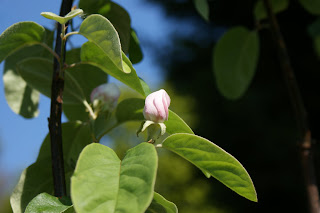

like palest pink icecream cones, small swirls of delicacy. At its foot, Jenny's geraniums mixed with bluebells have been covered with bees these last few days.
Opposite, on the cool side of the garden, Solomon's seal provides an elegant screen for the compost bin; at its best now, after flowering the fresh green leaves will soon be laced by feasting snails. It doesn't seem to hurt the plants as they return better every year.

like palest pink icecream cones, small swirls of delicacy. At its foot, Jenny's geraniums mixed with bluebells have been covered with bees these last few days.

 Down by the pond wilderness proliferates; periwinkle overcoming all before it, a glimpse of fig beginning to develop its overwintered fruits under bright green leaves, grasses creeping their way through everything and on the right, a clump of silvery green glistening iris leaves, still to bring forth their white flowers.

Last of the double daffs for the moment (some are still developing as I only potted them up in mid February. They need twelve weeks y'know). And finally, sneak preview of a new orange iris which I had hoped would be out in time for this month's bloom day (and will probably be done before June's). Just now the buds look like some strange water bird stretching its head above the rushes, with aquilegia flowers weird fairies gathering round.
Thanks as ever to Carol of May Dreams Gardens for hosting Gardeners Bloom Day every month, year round. Hop over there to find links to others' gardens from around the world.
Saturday, 27 March 2010
Ledum to the rescue for puncture wounds
Lovely spring day here, front garden looking very pretty in the sunshine with lemon primroses and pale daffs finally out, and a few purple anemones scattered along the bed. The daphne is now in full bloom - quite late this year, it's been putting out the odd flower since late February but the full "pompom effect" -and delicious scent - of the collective flowers has only flourished in the last ten days. The laurel berries have been slowly ripening from green to yellow since the snow went and are now bright scarlet. I expect they're poisonous; the birds don't eat them from this bush and you would think they would welcome fresh pickings at this time of year.
I should be on the allotment, but in the midst of clearing the strawberry bed I knelt on a rusty nail earlier this week. It went in about an inch, didn't bleed very much but I had to do a quick clean-up with some antiseptic wipes and a loose dressing, and come home.
Ledum and Hypericum are the indicated homeopathic remedies for this kind of deep puncture wound. I took 3 doses of Ledum 30 daily for 2 days. I also dabbed a bit of Calendula cream on the wound on the first day; this is a traditional antiseptic and it doesn't allow the wound to close up too quickly. This is important where there is the risk of tetanus (we use stable manure on the allotment and horse pee is the most likely source of Clostridium tetanii in the UK). The bug thrives in a sealed, oxygen free environment, hence the need for care when a wound is deep.
From the second day, when the wound felt a little warm and inflamed, I took three doses of Hypericum 30 daily, stopping after the sixth dose as the inflammation seemed to have gone.
My knee is still painful, but a mix of Arnica, Rhus Tox and Ruta 30 ( especially the latter) eases this considerably.
I spent most of the first two days in bed; grateful for the Garden magazine and Gardeners World which both popped through the letterbox for entertainment while I was laid up, but I also slept a lot - a shock reaction perhaps? I feel very fortunate that P is at home and was able to bring frequent cups of tea and food, in between groundwork for decorating the living room which we started on the day before my accident, planning to complete before the Easter break. Now I just have to be patient with myself, moving carefully between positions so I don't twist or strain the knee, while the process of healing takes its course.
The good news is that the first lettuce was coming through, planted under a cloche 2 weeks ago; and the first carrots, only put in one week before! Time to get some seedlings under way at home I think for later in the season...
I should be on the allotment, but in the midst of clearing the strawberry bed I knelt on a rusty nail earlier this week. It went in about an inch, didn't bleed very much but I had to do a quick clean-up with some antiseptic wipes and a loose dressing, and come home.
Ledum and Hypericum are the indicated homeopathic remedies for this kind of deep puncture wound. I took 3 doses of Ledum 30 daily for 2 days. I also dabbed a bit of Calendula cream on the wound on the first day; this is a traditional antiseptic and it doesn't allow the wound to close up too quickly. This is important where there is the risk of tetanus (we use stable manure on the allotment and horse pee is the most likely source of Clostridium tetanii in the UK). The bug thrives in a sealed, oxygen free environment, hence the need for care when a wound is deep.
From the second day, when the wound felt a little warm and inflamed, I took three doses of Hypericum 30 daily, stopping after the sixth dose as the inflammation seemed to have gone.
My knee is still painful, but a mix of Arnica, Rhus Tox and Ruta 30 ( especially the latter) eases this considerably.
I spent most of the first two days in bed; grateful for the Garden magazine and Gardeners World which both popped through the letterbox for entertainment while I was laid up, but I also slept a lot - a shock reaction perhaps? I feel very fortunate that P is at home and was able to bring frequent cups of tea and food, in between groundwork for decorating the living room which we started on the day before my accident, planning to complete before the Easter break. Now I just have to be patient with myself, moving carefully between positions so I don't twist or strain the knee, while the process of healing takes its course.
The good news is that the first lettuce was coming through, planted under a cloche 2 weeks ago; and the first carrots, only put in one week before! Time to get some seedlings under way at home I think for later in the season...
Saturday, 20 February 2010
Witch hazel blooms at Pembroke Lodge
To Pembroke Lodge in Richmond Park yesterday for lunch - hearty food designed to satisfy after a long walk on a cold day. Mum and I enjoyed jacket potatoes smothered with toasted cheese and red onion, P & W had pasta with a delicious tomato and veg sauce. Then a few turns round the gardens in the bitter cold; snowdrops carpeted a slope near the house, and gorgeous camellias flowering already, delicate pinks, creams and whites, one already carpeting the path below in fallen petals. Lastly we found three small hamamelis trees clustered together under the bare winter oaks and in full blossom; two golden yellow and one red, sweetly scenting the air.
Sunday, 24 January 2010
A little unseasonal piece...
I really shouldn't be here...gardening season doesn't start until March. But this afternoon I spent a couple of hours planting up strawberries.
Let me explain. I ordered 25 strawberry plants (plus rhubarb, raspberries and a blueberry bush) last autumn, expecting delivery in the first couple of weeks of November. But there was a postal strike here in the UK, so they weren't delivered until early December. By then I was busy with clinic, arrangements for 50th birthday party plus the usual Crimbo stuff.
I did eventually manage to open the box after about a fortnight and store it in the garage. I took out some of the plants so they weren't all squashed in the dark box, crossed my fingers and hoped everything would be cool enough over the next few weeks to remain in hibernation and alive.
It has been pretty cold. Not compared to the north of Britain perhaps, but still colder than usual for the balmy south east of England. We had a week of snow in December, which just about disappeared before the Christmas holiday, but the temperatures still were frosty every night and lower than we're used to. On New Year's Day we took a beautiful walk in the Surrey Hills, clear blue skies and bitter cold, so I wasn't worried about my plants then.
A few days later snow set in again, together with biting cold winds from the north.
The oak trees looked fabulous with their frosty outlines; blackthorn, curiously, as if it was in blossom; and the pine trees like fireworks, an effect we hadn't noticed before (I was planning to post some photos but Blogger won't let me this evening - maybe another day).
As always, it thawed, leaving the kids' giant snowballs looking like arty installations, or ancient monoliths. I was kept indoors for a few days by an illness, and then the weather turned cold and grey and rainy. So today is the first of the year when the plants in the garage have finally beckoned me out again, with the guilty feeling that if I don't do them this week, they may not survive.
I only got to them late this afternoon, because I was singing with Colliers Wood Chorus at Royal Festival Hall earlier on. (That was a lovely experience!) I needed some fresh, cold air and it was beautiful outside, still plenty of light as the sun went down, though it was dark by the time I finished my task around 5.30.
It was only about 3 degrees C outside, so possibly not the best of days to plant up anything.
I was surprised as I unrolled the plants from their plastic package, how large and well developed the roots were, and had to swap the three inch pots I'd planned for some twice the size, even then feeling that there wasn't quite enough room for the plants to develop. They were all very dry, but I hope that at least potting them up will keep enough alive to yield a reasonable crop in July this coming year.
Later this week, I plan to heel in the raspberry canes and plant out the rhubarb - if the weather is good enough to get down to the allotment.
Let me explain. I ordered 25 strawberry plants (plus rhubarb, raspberries and a blueberry bush) last autumn, expecting delivery in the first couple of weeks of November. But there was a postal strike here in the UK, so they weren't delivered until early December. By then I was busy with clinic, arrangements for 50th birthday party plus the usual Crimbo stuff.
I did eventually manage to open the box after about a fortnight and store it in the garage. I took out some of the plants so they weren't all squashed in the dark box, crossed my fingers and hoped everything would be cool enough over the next few weeks to remain in hibernation and alive.
It has been pretty cold. Not compared to the north of Britain perhaps, but still colder than usual for the balmy south east of England. We had a week of snow in December, which just about disappeared before the Christmas holiday, but the temperatures still were frosty every night and lower than we're used to. On New Year's Day we took a beautiful walk in the Surrey Hills, clear blue skies and bitter cold, so I wasn't worried about my plants then.
A few days later snow set in again, together with biting cold winds from the north.
The oak trees looked fabulous with their frosty outlines; blackthorn, curiously, as if it was in blossom; and the pine trees like fireworks, an effect we hadn't noticed before (I was planning to post some photos but Blogger won't let me this evening - maybe another day).
As always, it thawed, leaving the kids' giant snowballs looking like arty installations, or ancient monoliths. I was kept indoors for a few days by an illness, and then the weather turned cold and grey and rainy. So today is the first of the year when the plants in the garage have finally beckoned me out again, with the guilty feeling that if I don't do them this week, they may not survive.
I only got to them late this afternoon, because I was singing with Colliers Wood Chorus at Royal Festival Hall earlier on. (That was a lovely experience!) I needed some fresh, cold air and it was beautiful outside, still plenty of light as the sun went down, though it was dark by the time I finished my task around 5.30.
It was only about 3 degrees C outside, so possibly not the best of days to plant up anything.
I was surprised as I unrolled the plants from their plastic package, how large and well developed the roots were, and had to swap the three inch pots I'd planned for some twice the size, even then feeling that there wasn't quite enough room for the plants to develop. They were all very dry, but I hope that at least potting them up will keep enough alive to yield a reasonable crop in July this coming year.
Later this week, I plan to heel in the raspberry canes and plant out the rhubarb - if the weather is good enough to get down to the allotment.
Sunday, 22 November 2009
Famous albino squirrel and other autumn miscellany

Be not downhearted though. In our local paper the following week there was news of two more albino squirrels a few miles away in Carshalton, Surrey. Let's hope they're a bit more wary of the traffic.

Isn't this a gorgeous display of vegetables? I wish I could take the credit for them, but they came from uncle David's allotment. His sweetcorn did marvellously this season (you can see a beautiful pile of them at the back) but I'm also really jealous of that beautiful cabbage in the middle - maybe I'll try growing some next year.
Next, the last of the cornflowers, from the edges of a patch of meadowland, still bravely flowering (if a little the worse for wear) after the strong winds and pelting rain of the last 48 hours. They were quite luminous in the twilight, as only true blue can seem.
We found them up at the top of Cheam recreation ground, which is mostly football and rugby pitches, where it borders Nonsuch Park and has an amazing view across south London to the City and Canary Wharf beyond on a clear afternoon like today. Somebody (London Wildlife Trust? Local council? I've forgotten) planted up a gorgeous plot, about 30 metres square, with meadow and wild flowers, earlier this year and there were notices informing us that this was an experiment, and would be monitored for wild birds and other creatures. I first came across it in September when of course it was past its best, but still beautiful with poppies, cornflowers and sunflowers. l
One Sunday last month we walked past to find a flock of about two dozen bright green parakeets harvesting the sunflower seeds, a gorgeous sight; but I wonder if they were the wild life it was designed to attract? Not much left today to feed the smaller native seed eaters - goldfinches, greenfinches and the like.We found them up at the top of Cheam recreation ground, which is mostly football and rugby pitches, where it borders Nonsuch Park and has an amazing view across south London to the City and Canary Wharf beyond on a clear afternoon like today. Somebody (London Wildlife Trust? Local council? I've forgotten) planted up a gorgeous plot, about 30 metres square, with meadow and wild flowers, earlier this year and there were notices informing us that this was an experiment,
 and would be monitored for wild birds and other creatures. I first came across it in September when of course it was past its best, but still beautiful with poppies, cornflowers and sunflowers. l
Lastly, some English oaks in their autumn finery before the wind blows all the leaves away. Common enough round here, but they seem to be the last to change from green to copper then brown, so hold the final riches of autumn. They looked so warm and bright as the sun set late on Saturday afternoon. Looking at them feels almost like the physical need for summer sunshine, I stare and stare, greedily feeding on the warm bright colours, stoking up my inner fires before the cold grey winter really sets in.
 hold the final riches of autumn. They looked so warm and bright as the sun set late on Saturday afternoon. Looking at them feels almost like the physical need for summer sunshine, I stare and stare, greedily feeding on the warm bright colours, stoking up my inner fires before the cold grey winter really sets in.
Saturday, 21 November 2009
Beetroot brownies and mellow soupfulness
The monthly requirement for chocolate, part of life for more years than I care to remember, has left me this year, but suddenly it was back again last week. Perhaps it was the cold wet weather, but comforting soup and some chocolate brownies were definitely on the family menu.
We had some Jerusalem artichokes, which Jenny had brought to share round at choir practice. In recent high winds the plants had fallen over, bringing many of the tubers up to the surface, so she had dug them all up over the weekend. Together with some cauliflower from our allotment and a 120g piece of organic stilton, a pint of chicken stock and a chopped red onion sweated in butter, all whizzed together after about 40 minutes simmering, we had a gorgeous creamy, savoury soup for lunch.
The recipe for chocolate brownies was from Riverford Farm Cook Book and is a real treat. Start by melting together 250g dark chocolate and 200g unsalted butter in a bowl over hot water. Add 1 tablespoon Tia Maria (I used Camp coffee for a more intense flavour).
Meanwhile puree 250g cooked beetroot in a food processor. Add three eggs (one at a time), a drop of vanilla extract and 200g caster sugar and mix until smooth.
In another bowl, sift together 50g cocoa powder, 50g ground rice, 1 tsp baking powder and 100g ground almonds.
Stir the beetroot mixture into the melted chocolate & butter mix and then fold in the dry ingredients.
Use greaseproof paper to line a rectangular tin about 28 x 18 cm. pour in the mixture and put in oven mark 4 (180C). Bake for 30-35 mins until just firm to the touch; a skewer inserted in the centre should emerge slightly sticky.
Cool in the tin, cut up and serve.
The recipe says this is enough for 9 portions but I cut it into 20 as the chocolate is very intense, plus all the eggs and butter makes for quite a rich texture and flavour. Perhaps I should only have added a couple of teaspoons of the Camp coffee. Anyway, we've been enjoying the brownies all week!
We had some Jerusalem artichokes, which Jenny had brought to share round at choir practice. In recent high winds the plants had fallen over, bringing many of the tubers up to the surface, so she had dug them all up over the weekend. Together with some cauliflower from our allotment and a 120g piece of organic stilton, a pint of chicken stock and a chopped red onion sweated in butter, all whizzed together after about 40 minutes simmering, we had a gorgeous creamy, savoury soup for lunch.
The recipe for chocolate brownies was from Riverford Farm Cook Book and is a real treat. Start by melting together 250g dark chocolate and 200g unsalted butter in a bowl over hot water. Add 1 tablespoon Tia Maria (I used Camp coffee for a more intense flavour).
Meanwhile puree 250g cooked beetroot in a food processor. Add three eggs (one at a time), a drop of vanilla extract and 200g caster sugar and mix until smooth.
In another bowl, sift together 50g cocoa powder, 50g ground rice, 1 tsp baking powder and 100g ground almonds.
Stir the beetroot mixture into the melted chocolate & butter mix and then fold in the dry ingredients.
Use greaseproof paper to line a rectangular tin about 28 x 18 cm. pour in the mixture and put in oven mark 4 (180C). Bake for 30-35 mins until just firm to the touch; a skewer inserted in the centre should emerge slightly sticky.
Cool in the tin, cut up and serve.
The recipe says this is enough for 9 portions but I cut it into 20 as the chocolate is very intense, plus all the eggs and butter makes for quite a rich texture and flavour. Perhaps I should only have added a couple of teaspoons of the Camp coffee. Anyway, we've been enjoying the brownies all week!
Sunday, 8 November 2009
21st century fruit farming - one man's view.
My mother and I enjoyed a talk and tour round Park Farm in Great Holland with Mr Elsworth, who owns and runs it as a thriving enterprise, a few weekends ago. Having recently planted three fruit trees in our back garden I was interested to learn what I could about looking after them - and encouraging fruitfulness of course.
Along the way he also shed light on changes for small to medium sized fruit producers since he took over the farm from his father, who first established it in 1935. There's no doubt the environment has become very tough for them.
For a start, only about 1/6th of the farm's original 60 hectares of orchards, is now devoted to fruit. Most of what they grow is sold locally, mainly through their own shop - and none through supermarkets or wholesalers, the latter were an important route to market in his father's time. Mr Elsworth related his last experience of delivering Discovery apples, usually the first early variety of the English apple season, up to the London markets one year, when most other UK growers' crops had failed. A peculiarity of the local coastal climate had saved his crop and he sent them up by train, expecting a good price in conditions of scarcity. They didn't sell, and he hadn't sent any away since.
The farm is not organic and I was mildly amused by his brief summary of why not. Apparently people who support organics think you don't use chemicals to sort out pests and yet organic farmers do need to use them. He said the knack to producing good quality fruit was to grow healthy trees, then disease wouldn't take hold. To me that is exactly what organic growing is all about! Using as little chemicals as possible, and those from an approved list of poisons derived from natural substances. Ah well, no one is perfect.
Most of the work of the farm is done by human beings and it's no picnic running a farm of this size, much of the outdoor work with casual labour. Young people don't stay on in permanent employment - he's just got them trained and they move on to something else. He commented wryly that if he needs 16 people to prune or pick apples he has to ask 20 to come in as he knows about a fifth won't turn up. In his experience, migrant labourers are more reliable - partly because they live onsite during the season so he knows where to find them when needed!
Beyond the problems of farming, he also shared some useful information for we gardeners! He showed us the Writtle College method of picking apples - cupping the fruit in your hand and rolling, rather than tugging it off the branch so the stalk stays on and keeps the fruit sealed and whole for storage (if the apples don't roll off easily they aren't ready). And he shared a technique to use alongside pruning for perfectly formed fruit trees - small concrete weights made in egg cartons and hung on individual branches to encourage them to grow outwards rather than up, for better productivity. He also uses calcium foliar feeds as needed, as this nutrient is difficult to administer in any other form.
We were surprised to hear that honey bees are not as useful as they're cracked up to be for pollination of fruit trees! Apparently the lazy things don't come out unless the weather is warm
(not always the case in our British spring). Other insects ( including other types of bee) are hardier, out earlier, and seem to do the job as well. Plus, the more flowers are pollinated, the more tiny fruits have to be removed from the trees in early summer (thus incurring additional labour costs) in order to produce a good crop of evenly spaced healthy apples! Over the last couple of years, the local beekeeper has taken his hives elsewhere and the crop has been more than adequately pollinated in their absence.
Park Farm produces 40 varieties of apple and it's a real treat to visit the farm's shop and choose. This time we brought home George Cave, Blenheim Orange, Egremont Russet and Ashmead's Kernel, all of excellent quality. We also had three litres of their fresh unpasteurised apple juice, which is usually available in at least three different varieties and vastly superior to (even the good) stuff from supermarket chiller cabinets. They supply boxes of fruit - follow the link above for further information. And if you should be somewhere near Clacton, do drop in for local vegetables and other fresh foods - and try their recently opened coffee shop, which does very reasonable lunches and delicious home baked cakes and desserts.
Along the way he also shed light on changes for small to medium sized fruit producers since he took over the farm from his father, who first established it in 1935. There's no doubt the environment has become very tough for them.
For a start, only about 1/6th of the farm's original 60 hectares of orchards, is now devoted to fruit. Most of what they grow is sold locally, mainly through their own shop - and none through supermarkets or wholesalers, the latter were an important route to market in his father's time. Mr Elsworth related his last experience of delivering Discovery apples, usually the first early variety of the English apple season, up to the London markets one year, when most other UK growers' crops had failed. A peculiarity of the local coastal climate had saved his crop and he sent them up by train, expecting a good price in conditions of scarcity. They didn't sell, and he hadn't sent any away since.
The farm is not organic and I was mildly amused by his brief summary of why not. Apparently people who support organics think you don't use chemicals to sort out pests and yet organic farmers do need to use them. He said the knack to producing good quality fruit was to grow healthy trees, then disease wouldn't take hold. To me that is exactly what organic growing is all about! Using as little chemicals as possible, and those from an approved list of poisons derived from natural substances. Ah well, no one is perfect.
Most of the work of the farm is done by human beings and it's no picnic running a farm of this size, much of the outdoor work with casual labour. Young people don't stay on in permanent employment - he's just got them trained and they move on to something else. He commented wryly that if he needs 16 people to prune or pick apples he has to ask 20 to come in as he knows about a fifth won't turn up. In his experience, migrant labourers are more reliable - partly because they live onsite during the season so he knows where to find them when needed!
Beyond the problems of farming, he also shared some useful information for we gardeners! He showed us the Writtle College method of picking apples - cupping the fruit in your hand and rolling, rather than tugging it off the branch so the stalk stays on and keeps the fruit sealed and whole for storage (if the apples don't roll off easily they aren't ready). And he shared a technique to use alongside pruning for perfectly formed fruit trees - small concrete weights made in egg cartons and hung on individual branches to encourage them to grow outwards rather than up, for better productivity. He also uses calcium foliar feeds as needed, as this nutrient is difficult to administer in any other form.
We were surprised to hear that honey bees are not as useful as they're cracked up to be for pollination of fruit trees! Apparently the lazy things don't come out unless the weather is warm
(not always the case in our British spring). Other insects ( including other types of bee) are hardier, out earlier, and seem to do the job as well. Plus, the more flowers are pollinated, the more tiny fruits have to be removed from the trees in early summer (thus incurring additional labour costs) in order to produce a good crop of evenly spaced healthy apples! Over the last couple of years, the local beekeeper has taken his hives elsewhere and the crop has been more than adequately pollinated in their absence.
Park Farm produces 40 varieties of apple and it's a real treat to visit the farm's shop and choose. This time we brought home George Cave, Blenheim Orange, Egremont Russet and Ashmead's Kernel, all of excellent quality. We also had three litres of their fresh unpasteurised apple juice, which is usually available in at least three different varieties and vastly superior to (even the good) stuff from supermarket chiller cabinets. They supply boxes of fruit - follow the link above for further information. And if you should be somewhere near Clacton, do drop in for local vegetables and other fresh foods - and try their recently opened coffee shop, which does very reasonable lunches and delicious home baked cakes and desserts.
Wednesday, 4 November 2009
Soil Association director in Sutton
Patrick Holden, director of the Soil Association, will address the Surrey Organic Gardening Group on 27 November. The event, which marks the 40th anniversary of SOGG, is open to all with an interest in gardening, whether organic or aspiring to it.
His talk, from 7.30 pm, will take place at Milton Hall, Cooper Crescent, Carshalton. To reserve a place call Alastair 020 8669 6692.
His talk, from 7.30 pm, will take place at Milton Hall, Cooper Crescent, Carshalton. To reserve a place call Alastair 020 8669 6692.
Thursday, 29 October 2009
Painted lady visits autumn flowers
T


Glorious sunshine this morning tempted me out to clear the asters, their lavender glory over and gone to seed. The bright warmth brought out Eupatorium's flowers in full white starry fluffiness; the flowers smell astringent, but I had to get quite close to experience this. Still it attracted bumble bees and even a painted lady butterfly paid a prolonged visit to tap its nectar. Click on the photos to look more closely; in the first image, the antennae are very well defined, although the body looks soft and out of focus; in the third, the proboscis can be seen.
In our back garden, Cotinus coggyria is aflame, while the oak trees beyond the garden are just beginning to turn and shed the odd yellow and dry brown leaves. The dry weather continues though there was a little rain after I planted up tulip bulbs in pots last week. Much to my surprise, a self seeded dark pink Cosmos has bravely begun to flower today in the sunny bed. I had a patch of them last summer and this is the sole survivor - I wonder how long it will last?


Glorious sunshine this morning tempted me out to clear the asters, their lavender glory over and gone to seed. The bright warmth brought out Eupatorium's flowers in full white starry fluffiness; the flowers smell astringent, but I had to get quite close to experience this. Still it attracted bumble bees and even a painted lady butterfly paid a prolonged visit to tap its nectar. Click on the photos to look more closely; in the first image, the antennae are very well defined, although the body looks soft and out of focus; in the third, the proboscis can be seen.
In our back garden, Cotinus coggyria is aflame, while the oak trees beyond the garden are just beginning to turn and shed the odd yellow and dry brown leaves. The dry weather continues though there was a little rain after I planted up tulip bulbs in pots last week. Much to my surprise, a self seeded dark pink Cosmos has bravely begun to flower today in the sunny bed. I had a patch of them last summer and this is the sole survivor - I wonder how long it will last?
Thursday, 15 October 2009
Garden Bloggers Bloom Day October 2009

Welcome to the highlights of my garden on this sunny autumn day...thanks as always to MayDreams Gardens for hosting this monthly beautiful event, an opportunity to share and enjoy so many gardens around the world.
The front border is flourishing with aster and dark leaved Eupatorium especially joyful this month - the aster a little past their best, some have gone to seed but their cheerful little faces enjoying the sun
 and continuing to feed local bees and other beneficial insects.
  Eupatorium has had a tough autumn, it has been very hot and dry, at one point in September I realised it was drooping and slung a can of water over it. It was moved from another part of this bed last spring, I'm hopeful its many flowers are a sign of health not desperation!
Sedum, cyclamen, Euonymus and Euphorbia have all settled in well to their pot at the front door. They were planted out just a couple of weeks ago having hung around since late August - so that's a relief.
In the back garden, spectacular autumn colour f
 rom Hamamelis Vesna; the leaves turn rich brown, then take on a deep orange hues, some with red and yellow edges. Well worth the space it occupies at this time of year, it is said to grow up to 8 foot and I'm looking forward to it. (In the left corner, a glimpse of acid yellow Potentilla, still flowering. I mentioned its long season back in July).
Next, a new addition to the sunny border, Malus Gorgeous was completely irresistible with its sunset
 coloured crab apples, turning to red, from RHS Wisley a couple of weeks ago. We've also put in quince Meech's Prolific and an apple, Adam's Pearmain this week. It has
  taken eight years to decide which fruit trees to plant (I know, we could have had some decent crops by now!) but we finally agreed on our selection, and looking forward to the spring blossom lighting up the garden. All will need expert pruning in our modest garden in order to produce well and thrive without taking over!
A couple of fresh white cyclamen have lit up this terracotta pot,with its variegated holly and thyme, which thrived in a lightly shaded spot over summer.
Lastly, yellow flowers like this pretty specimen are borne above the Jerusalem artichoke, which was covered with them when we visited the allotment last week to plant out garlic and onions. A welcome veg bloom for October!
Sunday, 27 September 2009
Croquet at Polesden Lacey...
We've spent most of the weekend outdoors enjoying the warm bright autumn weather. No, not in the garden, but in the Surrey Hills of South East England, where we wandered through lovely woodland, catching a glimpse of a small wild deer on our way, to spend Saturday night at Tanners Hatch youth hostel with friends from Making Colliers Wood Happy.
Along the lane from the railway station, hedgerows were full of fruit; blackberries, rosehips, red honeysuckle berries and elderberries (even though many, it seemed, had been recently pruned). As we walked through the fields, we spotted a buzzard lazily circling, a pair of herons flew past, and a small flock of goldfinches.
The hostel is just across the valley from Polesden Lacey, a large 18th century house owned by the National Trust, so in under half an hour we were able to walk up this morning and enjoy a lazy lunchtime picnic on the sunny lawns. They have a new farm shop, so we made our own picnic with fresh bread and deli treats, as the restaurant wa s very busy with the usual Sunday lunchtime trade, and none of us wanted to be indoors queueing.
The house is set into the hillside, surrounded by landscaped terraced lawns, a walled garden, some less formal meadows, and overlooking a peaceful view of the wooded countryside. there are two croquet pitches laid out on one of the lawns. A game was irresistible; we all enjoyed a couple of rounds in the gorgeous sunshine, although none had a firm grasp of the rules.
As the third round began, I took the opportunity to explore the walled garden. A lovely mixed border along the outside, but what lay within?
I found series of separate small gardens devoted to different plants and layouts, with tall yew hedges dividing them. M y first discovery was an historic collection of bearded irises, not that any were in flower, but naturally the beds were neatly laid out and I imagine it will look wonderful from spring next year.
The rose garden was also very striking; the scent was delicious - alm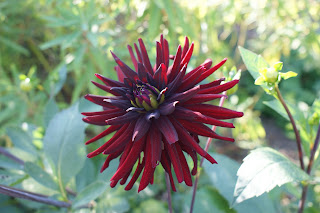 ost overwhelming - and the beds are planted up with single varieties, great blocks of colour which look absolutely wonderful.
I suppose no autumn posting would be complete without at least one chrysanthemum; in the corner of the rose garden there was a whole bed of them, acid yellows, bright scarlets, oranges and apricots and some dark pinks scattered among them. But they looked garish, rather than colourful, in my picture; so here's a single quite delicious bloom from a quieter bed!
As we started home along the Yew Walk (also a lawn) which constitutes the lowest boundary of Polesden Lacey's gardens, we noticed holly trees heavily laden with fruit, by tradition a sign of a hard winter coming. But there will be plenty here for the birds to eat, with the yew trees also thickly covered in small soft red jewels.
It's still possible to make a donation to WaterAid in support of Sing for Water 2009. And you can now see our performance on Youtube, where there are two ten minute videos of the 650 strong choir which came together from across the UK to the Scoop in London for this special event.

Along the lane from the railway station, hedgerows were full of fruit; blackberries, rosehips, red honeysuckle berries and elderberries (even though many, it seemed, had been recently pruned). As we walked through the fields, we spotted a buzzard lazily circling, a pair of herons flew past, and a small flock of goldfinches.
The hostel is just across the valley from Polesden Lacey, a large 18th century house owned by the National Trust, so in under half an hour we were able to walk up this morning and enjoy a lazy lunchtime picnic on the sunny lawns. They have a new farm shop, so we made our own picnic with fresh bread and deli treats, as the restaurant wa
 s very busy with the usual Sunday lunchtime trade, and none of us wanted to be indoors queueing.
The house is set into the hillside, surrounded by landscaped terraced lawns, a walled garden, some less formal meadows, and overlooking a peaceful view of the wooded countryside. there are two croquet pitches laid out on one of the lawns. A game was irresistible; we all enjoyed a couple of rounds in the gorgeous sunshine, although none had a firm grasp of the rules.
As the third round began, I took the opportunity to explore the walled garden. A lovely mixed border along the outside, but what lay within?
I found series of separate small gardens devoted to different plants and layouts, with tall yew hedges dividing them. M
 y first discovery was an historic collection of bearded irises, not that any were in flower, but naturally the beds were neatly laid out and I imagine it will look wonderful from spring next year.
The rose garden was also very striking; the scent was delicious - alm
 ost overwhelming - and the beds are planted up with single varieties, great blocks of colour which look absolutely wonderful.
I suppose no autumn posting would be complete without at least one chrysanthemum; in the corner of the rose garden there was a whole bed of them, acid yellows, bright scarlets, oranges and apricots and some dark pinks scattered among them. But they looked garish, rather than colourful, in my picture; so here's a single quite delicious bloom from a quieter bed!
As we started home along the Yew Walk (also a lawn) which constitutes the lowest boundary of Polesden Lacey's gardens, we noticed holly trees heavily laden with fruit, by tradition a sign of a hard winter coming. But there will be plenty here for the birds to eat, with the yew trees also thickly covered in small soft red jewels.
It's still possible to make a donation to WaterAid in support of Sing for Water 2009. And you can now see our performance on Youtube, where there are two ten minute videos of the 650 strong choir which came together from across the UK to the Scoop in London for this special event.
Tuesday, 8 September 2009
Any ideas for green figs?
 Even here in the blessed South East of England, you only get one picking of figs - and that's in a good year.
We picked our first crop of three purple ripe fruits last month from a Brown Turkey fig tree planted some five years ago. They were delicious.
But this week I twisted off 10 small green figs which have no chance of maturing, in the hope that some tiny buds will form, overwinter and ripen next summer.
Really I should have done this earlier in the season, and pruned, but fingers crossed we will have an Indian summer, the buds will form, and we will have a few figs to enjoy again next year.
Whether you've needed to water your garden this week or not, please support WaterAid this week and help them provide clean water supplies and sanitation for poor communities in Africa.
Subscribe to:
Posts (Atom)
